INTRODUCTION
With the rise in cases of voyeurism and the increasing use of technology to surreptitiously commit such offences, Parliament has recently enacted new provisions in the Penal Code to specifically deal with such offences. In particular, the new provisions are sections 377BB and 74A of the Penal Code. As both these provisions came into effect from 1 January 2020, there is still a lack of local reported judgments dealing with offenders charged under these new provisions. Due to the dearth of reported judgments, it is at present, unclear how offenders charged with voyeurism under these new provisions ought to be sentenced.
This article serves to provide a brief overview of the law in Singapore on voyeurism. It discusses the state of the law and sentencing practices under the old legislative framework and provides an analysis of the factors which Judges typically consider when sentencing in cases prosecuted under the former provisions and discusses how this is likely to be applied under these new provisions.
VOYEURISM AS AN OFFENCE – A BRIEF OVERVIEW
In order to appreciate the novelty of the new provision on voyeurism, it is necessary to first discuss how cases of voyeurism were previously dealt with under the law.
Previous Provisions
Voyeurism, was previously dealt with under Section 509 ‘Insulting the Modesty of a Woman’ in the Penal Code (Chapter 224) (Penal Code) and Section 29 and 30 of the Films Act (Chapter 107).
“S.509. Whoever, intending to insult the modesty of any woman, utters any word, makes any sound or gesture, or exhibits any object, intending that such word or sound shall be heard, or that such gesture or object shall be seen by such woman, or intrudes upon the privacy of such woman, shall be punished with imprisonment for a term which may extend to one year, or with fine, or with both.”
“S.29(1). Any person who makes or reproduces any obscene film (whether or not for the purposes of exhibition or distribution to any other person), knowing or having reasonable cause to believe the film to be obscene shall be guilty of an offence and shall be liable on conviction -…”
S.30(1). Any person who has in his possession any obscene film shall be guilty of an offence and shall be liable on conviction to a fine not exceeding $20,000 or to imprisonment for a term not exceeding 6 months or to both. – …”
Section 509 of the Penal Code was an archaic provision criminalising the “insulting of a woman’s modesty” it broadly covered acts from uttering any insulting words, making insulting sounds and gestures to acts constituting an intrusion into a woman’s privacy.
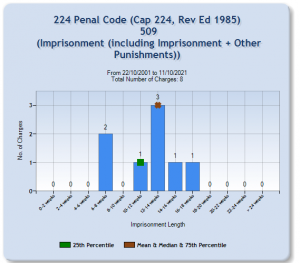
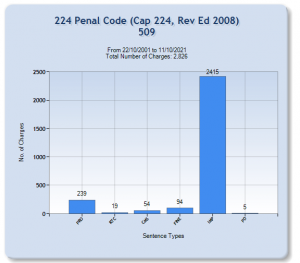
It appears, that prosecution under section 509 was waning. From 2001 to 2008, searches reveal that there were only 8 charges under section 509 of the Penal Code which have been dealt with by the Courts. From 2008 until 2021, it appears that there have been at least 2826 charges under section 509 dealt with by the Courts. These figures may not be completely accurate, but they do in our opinion, show that there has been a surge in prosecutions under this section since 2008. These figures are taken from the State Courts Sentencing Information Repository:
In our opinion, the increase in prosecutions under section 509 of the Penal Code coincided with technological advances. With cameras and recording devices becoming increasing accessible, smaller in size and better in quality, offenders started using such technology to commit acts of voyeurism. The problem was, there was no specific legislative provision to deal with this contemporary problem. The solution then was to essentially repurpose section 509 to deal with voyeurism offences. The provisions under the films act were also used in certain prosecutions relating to voyeuristic videos.
An illustration of the wide ambit of section 509 can be seen through two cases – In Public Prosecutor v Chandran s/o Natesan [2013] SGDC 33, the Defendant was charged under section 509 Penal code for the offence of uttering words intended to insult the modesty of a woman. In Public Prosecutor v Tan Huat Heng [2012] SGMC 1, the Defendant who was found guilty of the more severe offence of using his camera phone to take “up-skirt” videos of several women, was also charged under section 509 Penal code for insulting the modesty of several women.
A Need for Change
As discussed above, section 509 was a repurposed piece of legislation, but it was not adequately equipped to deal specifically with voyeurism. One of the issues of the old provision of S509 is that it was a gender specific offence, which required the victim to be a woman. This meant that voyeuristic videos taken of men without their consent could not be prosecuted under section 509 and had to be dealt with potentially under the films act, which led to different sentencing outcomes.
Secondly, section 509 did not contemplate the myriad of ways voyeurism could be committed. Hence, all offenders were subjected to the same range of punishments and the Courts were left to formulate aggravating factors to distinguish between varying degrees of culpability.
S.377BB’s gender neutral language recognises the harsh reality that any individual regardless their gender can potentially be a victim to voyeurism. The word “woman” is used in s. 509 has been replaced with “person” in S.377BB, to reflect the changing views and societal norms on the roles of men and women.
AN OVERVIEW OF S.377BB
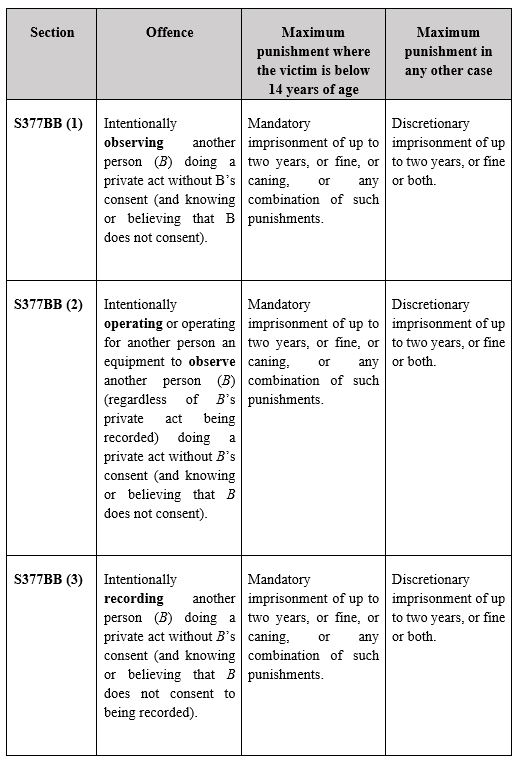
Section 377BB is a multi-layered section which makes provision for the many ways in which a person can commit an offence of voyeurism. At its most basic level, section 377BB(1) makes it an offence for a person (A) to observe another person (B) doing a private act without B’s consent (and with the knowledge or belief that B does not consent).
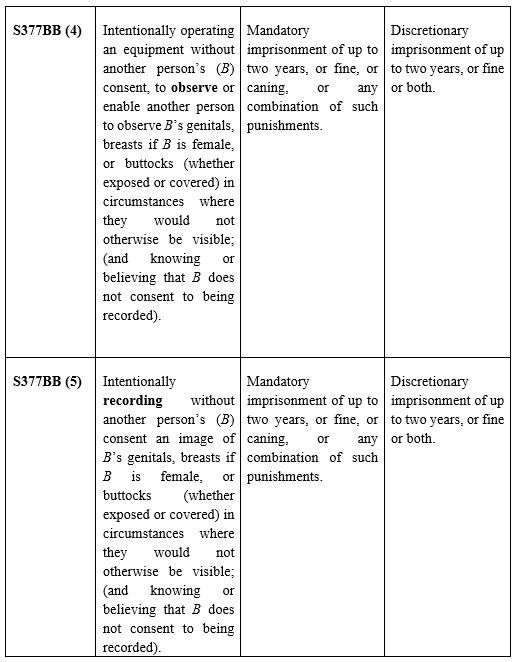
The other subsections (2), (3) gradually build on this and they target voyeurism which is achieved either through operating equipment to observe person (B) or in situations where person (A) intentionally or knowingly records person (B). Subsection (4) and (5) deals with the aggravated situation where person (A) operates equipment to observe or record (B)’s private parts.
The maximum sentence that can be imposed on an individual who is found guilty under S.377BB is 2 years imprisonment. This is double the previous maximum one-year punishment for the offence of insulting modesty under section 509. In addition, a fine or caning, or any such combination of all three punishments can also be imposed. Where the offence is committed against a person below 14 years old, imprisonment will be made mandatory. The prevalence of voyeurism cases imposes the need for a higher punishment to deter the proliferation of voyeuristic recordings.
The following table sets out the various iterations of an offence of voyeurism and the prescribed punishments:
AN OVERVIEW OF S.74A
S.74A of the Penal Code serves to enhance the protections accorded to various vulnerable groups in society. It does so by providing an increase in maximum punishments imposable for a specific offence of up to twice the maximum punishment specified for the offence. The Penal Code Review Committee (“PCRC”) notes that the aggravated punishment for offences committed against vulnerable individuals under the age of fourteen, “reflects the greater culpability and society’s more severe disapprobation of such conduct”.
SENTENCING FACTORS
The PCRC opined that the offence of recording another person doing another a private act, which is addressed in S.377BB (2) to (5), should not be subjected to whether there were any recordings made. That as long as an individual took active steps to make voyeuristic recordings, they could be charged with the offence of voyeurism.
The High Court decision in PP v Chong Hou En [2015] 3 SLR 222 (“Chong”) dealt with the offence of voyeurism under the former provision section 509 of the Penal Code. Despite this, it is likely to still remain relevant insofar as the aggravating and mitigating factors discussed in that decision are concerned. In Chong, the High Court held that the following are relevant sentencing considerations:
- The degree of planning by the offender;
- The degree of intrusion into the privacy of the victim (note: this will now be dealt with more formally as the prosecution will be able to charge an offender under sub-sections (4) and (5) where the private parts of the victim were intruded upon);
- The number of victims and young victims (note: again, this aggravating factor has been formalised in sub-section (8). Where the victim is a young offender under 14, it will become mandatory for the judge to enhance the sentence in such cases);
- The duration of the recording
What is not so clear is whether the range of sentences are going to increase across the board. One view is that it appears to be Parliament’s intention to enhance the sentences by increasing the maximum sentence for such offences as compared to its predecessor in section 509. However, the observation of the High Court in Chong, that “it is not appropriate to establish a custodial benchmark for offences (under s 509) involving the use of a recording device given that there are a myriad of ways in which such offences could be committed” underscores the fact that offenders’ culpability for voyeurism related offences spans across a wide spectrum. It would, in our opinion, be wise for the Courts to continue to then retain the full spectrum of sentencing options available to them under the new provisions of Section 377BB.
CONCLUSION
The introduction of S.377BB has made the offence of voyeurism gender-neutral and has also formalised some of the aggravating factors which Courts had typically taken into consideration when dealing with offenders charged under its predecessor section 509. It has enhanced the range of sentences to grant the Court greater flexibility in sentencing. It is still unclear whether the enhancements to the maximum sentences will lead the Courts to increase sentences across the board, however, considering the approach and attitudes of the Courts in sentencing offenders under the predecessor section, it appears that the Courts will want to retain the full range of available sentences to effectively deal with the myriad of ways such offences can be committed.